1st tone: in front
2nd tone: in the kitchen
3rd tone: in the living room
4th tone: in the bathroom
5th tone: on the roof
For me, when I remember a kitchen in an encampment, I know that the pinyin final (e)n2 is used for that character.
Pinyin final: "(e)n2"
/ə˧˥n/
The Pinyin final "(e)n2" is used in the second half of Pinyin syllables. In MandarinBanana's mnemonic system, the second half of a Pinyin syllable is always represented by a location. You can visit the Pinyin index to see all Pinyin syllables from this mnemonic group, or to see all Pinyin syllables "(e)n2" can appear in.
Pronunciation Tips
The “Cheat Code”
Think of “un-” in undo (the relaxed vowel), then close into an “n”—but keep it short, neutral, and not “en/ain.”
Mouth Mechanics (step-by-step)
- Start relaxed and central. Let your jaw hang slightly open and your tongue rest “lazy” in the middle of your mouth (not tense, not pulled back).
- Make a soft, plain vowel. Voice a quick, plain sound like the vowel in sofa (first “a”)—not a clear “eh” as in bed, and not “uh” as in book.
- Close into “n.” Without changing the vowel much, lift the tip of your tongue to touch the gum ridge right behind your upper front teeth.
- Let air go through the nose. Keep voicing as you close; the sound ends with a nasal “n” resonance.
- Stop cleanly. End the syllable firmly at -n (don’t trail off into an extra vowel).
Quick physical check: If you pinch your nose shut during the final -n, the sound should feel “blocked” at the end—because -n is nasal.
English Approximation (what to copy and what to change)
The exact vowel of (e)n isn’t a perfect English match, but you can get very close:
-
“un-” in undo → Use the vowel in un- and then end with n.
Match: the relaxed central vowel.
Change: keep it shorter and don’t stress it. -
The last sound in button (American pronunciation “butt-n”) → Focus on the quick, dull vowel quality before the “n.”
Match: the neutral, reduced vowel quality.
Change: make sure you still hear a brief vowel before n (not only an “n” sound). -
The first syllable of winter → Copy the win- vowel quality, but don’t turn it into “win”; keep it more central and less “i.”
Match: short vowel + n ending.
Change: relax the vowel so it doesn’t become a clear English “ih” (as in win).
Important note about spelling: In Pinyin, this final is written -en, but the vowel is often more like a relaxed “uh” than an English “eh.”
Common Mistakes (English speakers)
-
Mistake: Saying “en” like in pen (American English).
English pen has a clear “eh” vowel. Mandarin -en is usually more neutral/central, not a bright “eh.” -
Mistake: Turning it into “in.”
Especially after initials like x-, q-, j-, n-, l-, learners may drift toward a high “ee/ih” sound. Keep the vowel central, unless the syllable is actually -in (like yin2, pin2, lin2). -
Mistake: Adding an extra vowel after n (“en-uh”).
The syllable must end at n. No extra “uh” after the nasal. -
Mistake: Over-tensing the tongue or jaw.
This final likes a relaxed mouth. Tension pulls the vowel toward “ee” or “eh.”
Practice Pairs (visual anchors)
Approximate English words are only “training wheels”—use them to aim your mouth shape and timing.
| Pinyin (Final: (e)n2) | Approx. English anchor | What to copy |
|---|---|---|
| men2 | un- in undo | relaxed central vowel + n ending |
| fen2 | un- in until | quick, reduced vowel then n |
| gen2 | gun (but lighter) | short “uh”-like vowel + n (not “gah-n”) |
| hen2 | hun (but lighter) | central vowel + n, no extra vowel |
| shen2 | shun | “sh” + central vowel + n |
| ren2 | run (approx.) | central vowel + n; keep it smooth, not “rɚn” |
| cen2 | suns (first part “sun”) | central vowel + n ending |
| wen2 | one (approx.) | quick central vowel feeling, then n |
Comparisons & caveats (similar Pinyin sounds to watch)
A) -en vs -in
- -en (this sound): the vowel is central/neutral, then n. Examples: men2, fen2, gen2, hen2, shen2, ren2, cen2, wen2.
- -in: the vowel is high and front (closer to “ee/ih”), then n. Examples: yin2, pin2, nin2, lin2, xin2, min2, qin2.
How to keep them apart:
If your tongue is high and forward (like smiling “ee”), you’re drifting toward -in. For -en, keep the tongue more relaxed and central.
B) -en vs -eng
- -en ends with n: tongue tip touches the gum ridge (front-of-mouth closure).
- -eng ends with ng: the back of the tongue lifts (back-of-mouth closure).
Cue: -en = front nasal, -eng = back nasal.
C) -en vs -un / -wen type syllables
Some syllables include a w glide before the vowel (written -un after many initials, and wen with w-). Examples: tun2, lun2, hun2, run2, cun2, chun2, wen2.
- In tun2/lun2/hun2/run2/cun2/chun2, you start with rounded lips (w feeling) before the central vowel + n.
- In plain -en syllables like men2/fen2/gen2, you do not start with rounded lips.
D) -en vs -ün (-yun / -qun / -xun)
Examples: yun2, qun2, xun2 use a front, rounded vowel (like saying “ee” while rounding lips), then n.
Cue: If your lips are rounded and your tongue feels “ee-like,” that’s -ün, not -en.
E) Tone reminder for the examples (the “2” in (e)n2)
All given examples are second tone: start mid and rise. Keep the vowel short and steady while the pitch rises; don’t change the vowel quality as you rise.
Pinyin with (e)n2
Mnemonics for (e)n2
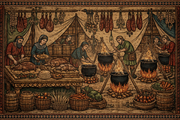
In the encampment’s kitchen.

Prompt snippets
Scene setting: woven into coarse wool and linen fibers using a restricted palette of deep crimson, indigo, olive green, and aged gold, this scene depicts a bustling, large-scale kitchen within the medieval encampment. Stiff, two-dimensional figures, defined by heavy dark outlines and rendered in simplified forms. Large tripod cooking structures support blocky black cauldrons over the flames, while an ornamental, carved wooden table is heavy with stylized depictions of roasted boars, stacked loaves of flatbread, and bundles of coarse-threaded vegetables. The surrounding area features racks of hanging cured meats and dried herbs, all woven with flat, geometric patterns onto the rough-textured background. Baskets of unidentifiable root vegetables and stacked, rough-hewn wooden barrels are clustered against the woven boundary, defined by a simple, repeating geometric pattern along the tapestry's border.
Characters with (e)n2